
Every generation of tools reshapes the question of what expertise means. The spreadsheet did not make accountants obsolete — it made the question of what the numbers imply more consequential. The word processor did not diminish writers — it elevated the ones who understood what was worth saying.
AI-assisted development has done the same thing to software engineering. The tools — GitHub Copilot, Cursor, Claude Code, and what comes after them — have automated the execution layer of the craft. Code is generated faster than it can be fully understood. Tests are written before the logic they verify is fully thought through. Engineers ship at volumes that were impossible two years ago.
And somewhere in this acceleration, the role of the tech lead quietly broke in two.
We named what happened to engineers. Vibe coding. The practice of directing AI tools to generate code, reviewing the output by judgment and intuition, shipping faster than a team could have written. It spread widely. Junior engineers producing at volumes that once required seniority. PRs merging that nobody fully understood at the line level.
We never named what happened to tech leads.
Until now.
Introducing the Vibe Leader
A Vibe Leader is not a vibe coder with a title.
A Vibe Leader is what the tech lead role becomes when AI handles the execution layer: someone who operates entirely at the level of judgment — above the code, where taste, context, and architectural intuition replace output as the primary measure of value.
The word vibe is deliberate. Not vague. Not casual. The vibe of a system — the coherence you feel when every decision is consistent, when the architecture holds up three years later, when a new engineer can read the codebase and understand not just what it does but why — is among the hardest things to create and the easiest to destroy. It cannot be generated. It must be cultivated.
Vibe Leaders cultivate it. Vibe coders with titles erode it.
The distance between these two is the most consequential divide in engineering leadership today. Most organizations cannot yet tell them apart. Most performance frameworks cannot measure the difference. Most tech leads have not yet decided which path they are on.
This article is about making that choice explicit.
What AI-Assisted Development Actually Changed
To understand the Vibe Leader, you first have to understand what AI tools automated — and, crucially, what they did not.
Tech leads have always held two jobs simultaneously. These jobs were rarely separated clearly enough to discuss distinctly, which is part of why the shift has been so disorienting.
The output job: Writing and reviewing code. Unblocking engineers. Answering “how do I do X in framework Y.” Debugging the production incident at 2am. Reviewing the PR the junior wrote about the authentication flow.
The judgment job: Deciding what to build next. Choosing the architecture that won’t paint the team into a corner in eighteen months. Saying no to the feature that sounds simple but isn’t. Knowing which technical debt to pay now and which to defer. Building the trust structures that allow a team to ship without constant escalation.
AI coding tools automated the output job. Almost completely.
What AI tools handle today:
──────────────────────────────────────────────────────────────

Code generation             ██████████████████████  90%+ automated
Boilerplate & scaffolding   ████████████████████    95%+ automated
Test writing                ████████████████████    90%+ automated
Documentation               ████████████████████    85%+ automated
Debugging common errors     ██████████████████      80%+ automated
PR explanations             ████████████████        75%+ automated
Framework Q&A               ████████████████████    95%+ automated
"How does this code work"   █████████████████       80%+ automated

What they cannot do:
──────────────────────────────────────────────────────────────

Deciding which of three valid architectures fits this org  ──  0%
Knowing the technical decision made 14 months ago and why  ──  0%
Feeling when sprint scope has become quietly un-shippable  ──  0%
Building the trust that lets a team self-organize          ──  0%
Recognizing when the product spec is the actual bug        ──  0%
Understanding the political constraints on tech choice     ──  0%
Everything in that second list is the Vibe Leader’s entire job description.
The output job was never the source of a tech lead’s real value. It was the most visible part — the part that generated immediate feedback, grateful engineers, measurable artifacts. AI tools removed that visibility, leaving only the value. And in doing so, they forced every tech lead to either operate at the level that remains, or acknowledge that they were mostly doing the visible part all along.
That is a confronting thing to realize. It is also a clarifying one.
The Split: One Title, Two Completely Different Roles
The tech lead title didn’t disappear. It fractured — into two roles that look similar from outside but function entirely differently, operating at different levels of the engineering stack.
THE TECH LEAD ROLE BEFORE AI TOOLS
──────────────────────────────────────

     ┌─────────────────────────────────────┐
     │             TECH LEAD               │
     │                                     │
     │  ● Write & review code              │  ◄── Visible, daily feedback
     │  ● Unblock engineers                │  ◄── Measurable, immediate
     │  ● Answer technical questions       │  ◄── Heroic, recognized
     │  ● Debug production issues          │  ◄── Clear before/after state
     │                                     │
     │  ● Architecture decisions           │  ◄── Invisible, slow feedback
     │  ● Scope & risk judgment            │  ◄── Hard to measure
     │  ● Team trust building              │  ◄── Takes quarters, not sprints
     │  ● Context preservation             │  ◄── Nobody notices until gone
     └─────────────────────────────────────┘


THE TECH LEAD ROLE AFTER AI TOOLS
──────────────────────────────────────

  ┌──────────────────────────┐    ┌──────────────────────────┐
  │  AUTOMATED (AI tools)    │    │  VIBE LEADER (human)     │
  │                          │    │                          │
  │  ● Code generation       │    │  ● Architecture          │
  │  ● Test writing          │    │  ● Scope judgment        │
  │  ● Documentation         │    │  ● Risk assessment       │
  │  ● Debug loops           │    │  ● Context keeping       │
  │  ● Framework Q&A         │    │  ● Trust building        │
  │  ● PR descriptions       │    │  ● System coherence      │
  └──────────────────────────┘    └──────────────────────────┘

  The left box was roughly 60% of the visible job.
  The right box is now 100% of what matters.
The Vibe Leader inhabits the right box entirely. They have let go of the left — not because they lack the skill, but because doing it themselves is now the worst possible use of their leverage. A surgeon who insists on sterilizing their own instruments is not demonstrating commitment. They are misallocating the most scarce resource in the operating room.
The Crisis Nobody Named
Here is the structural argument for why the Vibe Leader role is not optional — it is load-bearing.
Before AI tools, a senior IC produced roughly 200–500 lines of meaningful production code per day. A tech lead reviewing everything could read, understand, and genuinely evaluate the full delta entering the codebase each week. Their mental model of the system stayed current.
With AI-assisted development, that same IC produces 1,500 to 3,000 lines per day. The quality of individual lines is often higher. The code looks correct. It has tests. It handles edge cases. It passes review.
THE REVIEW CAPACITY GAP
────────────────────────────────────────────────────────────────

Before AI tools:

  IC daily output:      ████████  ~300 lines/day
  TL review capacity:   ████████  can fully understand what ships

After AI tools:

  IC daily output:      █████████████████████████████████  ~2,000 lines/day
  TL review capacity:   ████████  unchanged

                                  █████████████████████████
                                  This gap is accumulating
                                  complexity that no human
                                  fully understands.
                                  It is not in any metric.
                                  But it compounds every sprint.
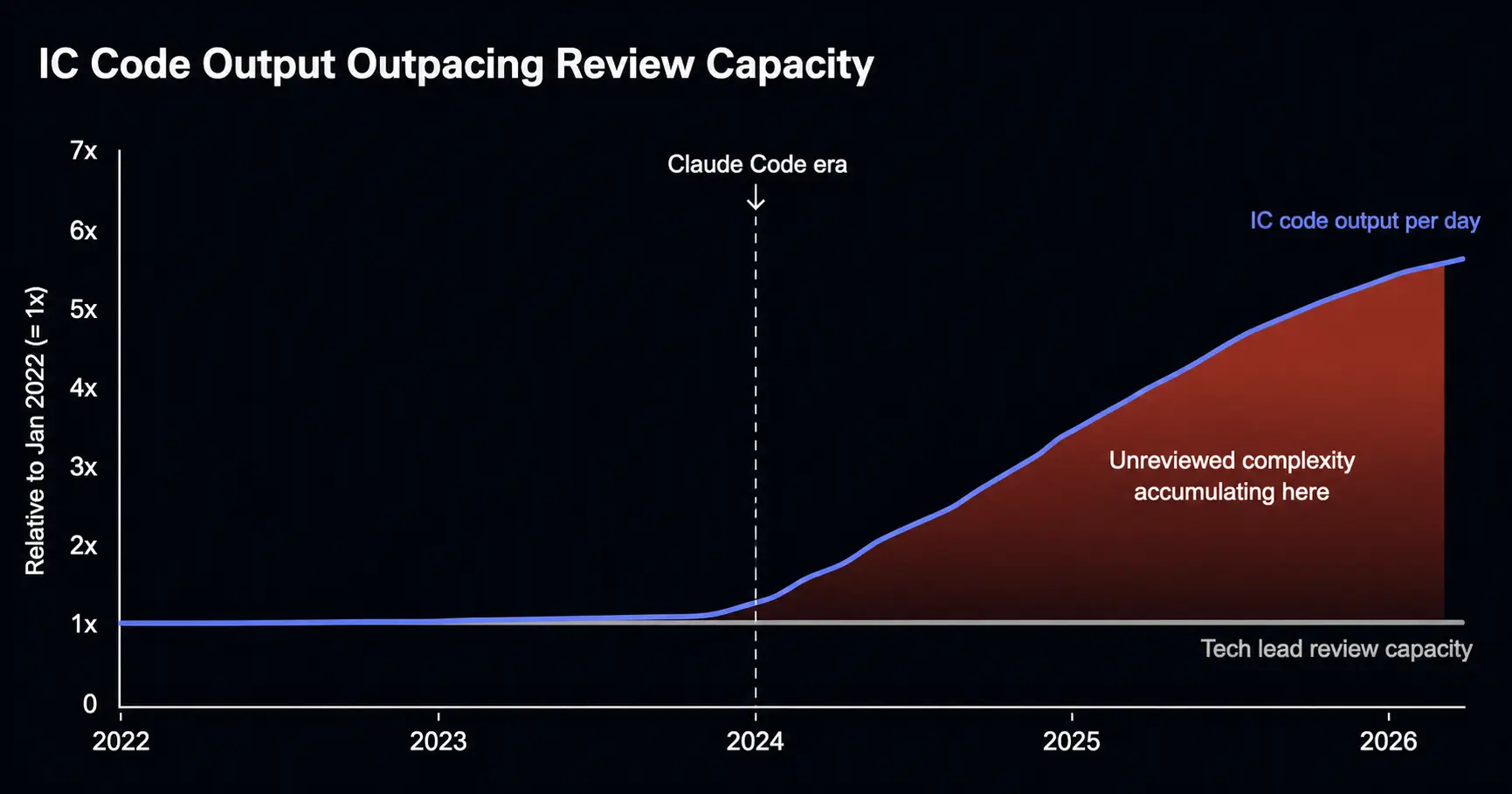
A tech lead who tries to bridge this gap by reviewing more code will fail. There are not enough hours. The math is not close. The Vibe Leader bridges it differently — by controlling what enters the gap in the first place, through precise scope, explicit architecture, and a team that genuinely understands the system they are building.
The gap is not a problem to be solved by working harder. It is the permanent condition of AI-augmented engineering. The Vibe Leader exists because someone must manage the space between what AI generates and what humans actually understand. If nobody is doing that job, the gap fills with complexity that looks like progress until it doesn’t.
The Five Disciplines of the Vibe Leader
Vibe Leadership is not a personality type or a disposition. It is a set of concrete disciplines — each one directly addressing a gap that AI tools created at the level below.
Discipline 1 — The Judgment Layer
AI coding tools generate solutions. Multiple solutions. Often four or five plausible, well-commented approaches to any given problem. The bottleneck has shifted from generation to evaluation.
The question is no longer “can someone write this?” It is “of the approaches the AI just produced, which one do we want in our codebase in three years?”
THE SHIFTED BOTTLENECK
──────────────────────────────────────────────────────

Before:  [Understand] → [Design] → [Write] → [Review] → [Ship]
                                      ↑
                                 bottleneck here

After:   [Understand] → [Design] → [Generate] → [Evaluate] → [Ship]
                                                     ↑
                                       Vibe Leader operates here
Answering that evaluation question requires knowing things no AI tool will ever know: what complexity costs when you are debugging at scale, which abstractions tend to leak in ways only visible six months later, where the organizational seams are that make certain solutions painful to maintain, what the codebase’s current shape implies about which direction is cheapest to extend.
This is taste in the deepest sense of the word. Not aesthetic preference, but calibrated judgment built from scar tissue, pattern recognition, and an intimate understanding of how this particular system, built by this particular team, for this particular domain, tends to fail. It is the Vibe Leader’s primary contribution — the thing that cannot be generated, only accumulated.
Discipline 2 — Context Keeping
AI tools know what the code says. They have no access to why the code says it.
They do not know that the authentication service is structured as it is because of a compliance requirement added in Q3 of last year. They do not know that LegacyUserAdapter exists because of a specific enterprise customer whose contract forbids breaking API changes. They do not know that the team tried the “obvious” microservices split eighteen months ago and rolled it back after two months of operational pain.
THE CONTEXT GRADIENT
────────────────────────────────────────────────────────────────

High    WHY decisions were made
value   Constraints not visible in the code
  │     Failed approaches and why they failed
  │     Political and organizational constraints on technical choice
  │
  │     ◄── AI tools have zero access here.
  │         This disappears when people leave.
  │         The Vibe Leader's job is to preserve and transmit it.
  │
Low     WHAT the current code does
value   HOW it implements each feature
  │
  │     ◄── AI tools handle this completely.
As code generation accelerates, decisions get made faster — and the context needed to make them correctly becomes more critical, not less. The WHY accumulates as invisible institutional knowledge until someone leaves and takes it with them, at which point it becomes invisible technical debt.
The Vibe Leader makes the WHY legible: decision logs, architecture documents, explicit team conversations where the reasoning behind choices is stated and recorded. In a world where code is cheap to generate, the most expensive thing in software development is losing the context that explains why the system is shaped the way it is. A codebase without that context is not an asset. It is a liability that happens to compile.
Discipline 3 — Scope Definition
The rate at which code can be generated now massively exceeds the rate at which requirements can be clarified. This is the new fundamental tension in software delivery.
THE AMBIGUITY-SPEED GAP
────────────────────────────────────────────────────────────────

2024 (before AI tools):

  Requirement clarity:    ████████████░░░░  70% clear at sprint start
  Implementation speed:   ██████░░░░░░░░░░  slow enough to discover gaps
  Result: gaps resolved before they become production code

2026 (with AI tools):

  Requirement clarity:    ████████████░░░░  still 70% clear
  Implementation speed:   ████████████████  fast enough to outrun gaps
  Result: gaps baked into working, tested, merged code
          that must now be fully rewritten
An engineer with AI assistance can produce a working, tested implementation of an ambiguous feature in an afternoon. Before AI tools, the implementation time was long enough that ambiguity usually surfaced and got resolved before the code was complete. The friction was protective. That protection is gone.
The Vibe Leader is the rate limiter — not on code production, but on ambiguity entering the development pipeline. Their job is to define scope precisely enough that the AI-augmented engineer builds the right thing without first building a complete, working, wrong thing. This means writing acceptance criteria specific enough to be falsifiable. Having the “what does done actually mean” conversation before the sprint starts. Being willing to delay a ticket two days to clarify the specification rather than accept a week of rework afterward.
Scope definition is not a planning ritual. It is the primary intervention that determines whether a sprint produces value or produces the appearance of value.
Discipline 4 — Complexity Budget Management
Every system has a complexity budget — an implicit limit on how much structural complexity it can absorb before becoming unreliable and dangerous to change. Before AI tools, this budget was managed, imperfectly but effectively, by the friction of writing code. Writing complex code took time. Engineers had to think through implications. The cost was a natural filter.
AI tools removed the friction. Writing complex code is now nearly as fast as writing simple code. The natural check on complexity accumulation is gone, and no new check has replaced it.
COMPLEXITY WITHOUT ACTIVE MANAGEMENT
────────────────────────────────────────────────────────────────

Pre-AI tools:
│     ╭──────────────────────────  Grows, but slowly.
│    ╭╯                            Natural friction limits the rate.
│───╭╯
└────────────────────────────────────────────────► time

Post-AI tools (no Vibe Leader):
│                         ╭───────  Manageable threshold exceeded.
│                    ╭────╯         System becomes hard to reason about.
│               ╭────╯              Incidents get harder to diagnose.
│          ╭────╯
│─────╭────╯
└────────────────────────────────────────────────► time

Post-AI tools (Vibe Leader managing):
│     ╭──────╮ ╭──────╮            Deliberate simplification
│    ╭╯       ╰╯       ╰──────╮    keeps complexity bounded.
│───╭╯                        ╰──  System stays understandable.
└────────────────────────────────────────────────► time
The Vibe Leader actively manages the complexity budget — deciding where complexity is justified and where it accumulates without sufficient reason. This means rejecting working code that adds unjustified structural complexity, even when it passes every test. It means scheduling explicit simplification: treating accumulated complexity as the defect it actually is, not the feature it appears to be. It means building a team culture where “this works, but it’s too complex” is a valid reason to ship something different.
Complexity management is unglamorous. It produces no new features. It closes no tickets. It is among the highest-leverage things a Vibe Leader does.
Discipline 5 — Ownership Architecture
When AI tools write the code, who owns it? Not legally — practically. Who understands it deeply enough to debug it at 2am? Who can explain why it was written that way? Who knows what will break if you change it?
In many teams using AI assistance aggressively, the honest answer is: nobody.
THE OWNERSHIP GAP
────────────────────────────────────────────────────────────────

Healthy team ownership:

  Module A  ──►  Engineer 1   deep understanding, can modify safely
  Module B  ──►  Engineer 2   deep understanding, can modify safely
  Module C  ──►  Engineer 3   deep understanding, can modify safely

AI-augmented team without a Vibe Leader:

  Module A  ──►  AI + Engineer 1  │
  Module B  ──►  AI + Engineer 1  │ "Ask the AI" is not ownership.
  Module C  ──►  AI + Engineer 1  │ Nobody fully understands
  Module D  ──►  AI + Engineer 2  │ the implications of changing
  Module E  ──►  AI + Engineer 2  │ any piece of any module.
  Module F  ──►  AI + Engineer 3  │
Code that no human deeply understands is a liability disguised as an asset. The fact that an AI can regenerate an explanation of it on demand does not constitute ownership. Understanding is not retrieval. It is the capacity to reason about something — to predict its failure modes, to anticipate the consequences of changes, to hold its logic in mind while modifying an adjacent system.
The Vibe Leader architects ownership: ensuring that for every significant piece of the system, at least one human genuinely understands it. Not a human who can prompt an AI to explain it, but a human who can reason about it independently. This requires explicit ownership assignment, review practices that test understanding rather than just correctness, and deliberate rotation that builds depth across the team.
What a Vibe Leader Is Not
There is a failure mode that currently masquerades as the Vibe Leader. It needs its own name.
Call them cursor jockeys — tech leads who use AI tools to do more of the output job themselves, rather than stepping back to the judgment layer. Their commit counts are impressive. Their visible output is high. They feel productive. They present, in every metric the organization currently tracks, as high performers.
Meanwhile, the five disciplines are not being exercised. Nobody is defining scope precisely enough before development starts. The complexity budget is unmanaged. Institutional context is decaying. Ownership is diffuse.
CURSOR JOCKEY vs VIBE LEADER
────────────────────────────────────────────────────────────────

Cursor Jockey (failure mode):
  ● Uses AI tools to ship more code personally
  ● Reviews AI output for syntax and correctness
  ● Debugs incidents with AI assistance
  ● High commit count. Visible. Rewarded by old metrics.

  Missing:
  ○ Scope definition before development starts
  ○ Complexity budget management
  ○ Context preservation and documentation
  ○ Team ownership depth cultivation
  ○ Architectural coherence at system level

Vibe Leader (the evolved role):
  ● Rarely writes code. Frequently shapes what gets written.
  ● Reviews AI output for architectural soundness and judgment
  ● Prevents incidents through clarity, not heroism
  ● Low commit count. Invisible. Undervalued by old metrics.

  Delivers:
  ✓ Sprints that close because scope was right at the start
  ✓ Systems that remain understandable as they grow
  ✓ Teams that self-organize because context is preserved
  ✓ Incidents that don't repeat because ownership is clear
The cursor jockey failure mode is seductive because it produces immediate, measurable output. The Vibe Leader’s work is invisible until it isn’t done — and by then, the team has spent a quarter on rework nobody accounted for, a system that nobody can debug, a sprint that collapsed because three features touched the same unowned module.
The deepest irony is that the cursor jockey looks more like a tech lead, by every traditional measure, than the Vibe Leader does. The old metrics were built for the output job. The output job is now automated. The metrics have not caught up.
A Week in the Life
| Activity | Cursor Jockey | Vibe Leader |
|---|---|---|
| Writing code | 30–40% of time | <5% of time |
| PR review | Syntax, logic, style | Architectural soundness, judgment quality |
| Architecture decisions | Reactive, ad-hoc | 30–40% of time, proactive |
| Scope definition | Minimal | 25–30% of time — before development starts |
| Unblocking engineers | 15–20% of time | <5% (AI tools handle most of this) |
| Context documentation | Rarely explicit | 15–20% — continuous and structured |
| Complexity management | When it becomes a crisis | Scheduled, preventive |
| Team depth building | Occasionally | Continuous — part of every sprint |
The Vibe Leader spends more than half their week producing no code and closing no tickets. They are writing specifications. Documenting decisions. Having the conversation about what “done” actually means before development starts. Identifying complexity accumulation before it becomes a crisis.
This work is invisible until it isn’t done. Which is precisely why organizations consistently under-invest in it, and why the leaders who do it are chronically undervalued — until the quarter where the absence of their work becomes obvious, as rework, as incidents, as architectural drift that nobody can explain.
The New Leverage
The Vibe Leader has more leverage than any tech lead in the pre-AI era. This is not a marginal improvement. It is a structural change in the nature of engineering leadership.
In 2023, a tech lead could 2–3x their team’s output through better code and sharper review. Their leverage was bounded by their personal hours. They were, fundamentally, a high-skilled producer adding to the team’s total output.
In 2026, a Vibe Leader can 5–10x their team’s effective output — not by producing more themselves, but by eliminating the friction that makes AI-augmented engineers slow. Every ambiguous requirement clarified before the sprint starts prevents two days of rework. Every architectural decision made explicitly and documented clearly prevents six weeks of accumulated drift. Every ownership gap closed prevents an incident that shuts the team down for a week.
LEVERAGE COMPARISON
────────────────────────────────────────────────────────────────

2023 Tech Lead:

  Team output = Σ(IC output) + TL code + TL review quality
                ─────────────────────────────────────────────
                Additive. Bounded by personal hours.
  Multiplier: 1.5x – 3x

2026 Vibe Leader:

  Team output = Σ(IC × AI multiplier) × Vibe Leader judgment quality
                                        ──────────────────────────────
                                        Multiplicative. Not bounded
                                        by personal hours.
  Multiplier: 0.5x (poor judgment) → 10x (excellent judgment)
The relationship shifted from additive to multiplicative. The stakes changed accordingly. A Vibe Leader who makes poor architectural decisions now propagates those decisions across ten times the code volume. A Vibe Leader who defines scope clearly now delivers ten times the right implementation. The feedback loops are slower, the blast radius is larger in both directions, and the irreducible requirement for genuine judgment — not process, not output, judgment — has never been higher.
How to Recognize a Vibe Leader
Organizations are measuring the wrong things.
They are looking at sprint velocity. Ticket closure rates. Code review turnaround time. PR merge rates. These are output metrics from the pre-AI era — designed to capture the output job, which is now automated. Using them to evaluate Vibe Leaders is like measuring a surgeon’s value by how many scalpels they cleaned.
The Vibe Leader’s work has no native metrics. You cannot put “architectural coherence maintained this quarter” in a performance review with a number attached. You cannot quantify context preservation.
This creates a dangerous evaluation gap. Vibe Leaders appear less productive by the old measures. Cursor jockeys appear more productive. Over time, organizations optimize for the wrong role and wonder why their AI-augmented teams keep producing impressive velocity and disappointing outcomes.
The question every engineering leader should be asking: If our team’s AI-generated code volume tripled tomorrow, would the judgment quality holding it together scale proportionally?
If the answer is no — if the judgment layer is not growing as fast as the code layer — then the gap between those rates is the risk accumulating invisibly in the system. No dashboard is showing it to you.
Signs your team has a Vibe Leader:
- Sprints close consistently because scope is defined clearly before they start
- New engineers can read the codebase and understand why, not just what
- Incidents are rare; when they happen, they’re diagnosed quickly because ownership is clear
- Architectural decisions from 18 months ago still make sense today
- The tech lead is rarely in debugging sessions but often in specification sessions
Signs your team has a cursor jockey:
- High PR velocity but frequent rewrites of features just shipped
- Recurring incidents in the same modules
- New engineers cannot modify code confidently without AI assistance to explain it
- Architecture drifts feature by feature without anyone noticing until it’s a crisis
- The tech lead is the busiest person on the team — and the team depends on that
Becoming a Vibe Leader
If you are currently a tech lead and AI tools have entered your team’s workflow, the practical question is what to do differently starting Monday.
Stop competing on output. You will not out-code an AI tool. You will not out-review a team augmented by AI. Attempting to do so is not productivity — it is avoidance. The moment you release output as your primary contribution, the judgment layer becomes accessible.
Write the WHY explicitly. Every significant technical decision made this week should have a written record — not a PR description, but a decision document. Why this approach over the alternatives. What constraints shaped it. What the known tradeoffs are. This is the context no AI tool will ever have and future engineers will desperately need.
Own the sprint scope, not the sprint tickets. Your job is to ensure every ticket entering a sprint is defined precisely enough that an AI-augmented engineer can build the right thing without first building the wrong thing. This is a different job than picking tickets or estimating story points.
Schedule simplification. Every sprint should include explicit capacity for removing complexity, not just adding features. Make it a line item. Give it an owner. Treat accumulated complexity as the defect it actually is.
Assign ownership explicitly. For every significant module, there should be a named human who understands it deeply — not who wrote it, not who last touched it, but who currently owns understanding it well enough to modify it safely. Publish that list. Update it when it changes.
The Vibe Leader Is Not a New Concept — It Is an Old One, Finally Made Visible
The best tech leads were always doing this work. They were always operating at the judgment layer — holding context, defining scope precisely, managing complexity deliberately, building genuine ownership across their teams. The output job was a constant interruption of the real work, dressed up as the real work because it was the part you could see.
What changed is that AI tools made the execution layer disappear. And with it, the visibility of the leaders who had been doing the deeper work all along.
The Vibe Leader is not a role invented by AI tools. It is the tech lead role with the scaffolding removed. What remains is the load-bearing structure that was holding everything up while people focused on the scaffolding.
Now that the scaffolding is gone, everyone can see the structure.
There is a version of this moment that is clarifying. The best leaders — the ones who were always operating at the judgment layer — are suddenly visible in a way they never were before. Their value is not displaced. It is revealed.
There is another version that is disorienting. Leaders who built their identity around the output job are realizing that the scaffolding they were maintaining has been automated, and what remains is the harder question of whether they were ever, really, doing the work underneath it.
Both versions are happening simultaneously. Across teams, across organizations, across the industry — right now.
The question is which one describes you.
Written by Neel Shah — Tech Lead & Senior Data Engineer, Ottawa. Building teams that need a Vibe Leader? Let’s talk: hire@neelshah18.com